




Renaturalisation of Olas de la Mar Bella Park
Cristina Valle, Carina Mato, María Emilia Vanoli, Rosa Gorgues and Nevay Bastidas, students on the Professional Master’s Degree in Landscape Architecture and Sustainable Urbanism at ESDESIGN, present their project, Olas de la Mar Bella.
Olas de la Mar Bella proposes a new way of understanding Barcelona’s urban coastline through the landscape transformation of Mar Bella Beach, Llevant Beach and the Fòrum waterfront platform, integrating nature, city and coastline into a continuous, resilient and liveable system.
The project focuses on the regeneration of the seafront in response to the main contemporary challenges: the climate emergency, biodiversity loss, soil sealing and the historic disconnection between the city and the sea. Based on a rigorous analysis of the metropolitan context, the proposal redefines this area as a large coastal park that gives public space back to the community and encourages the emergence of new urban ecosystems.
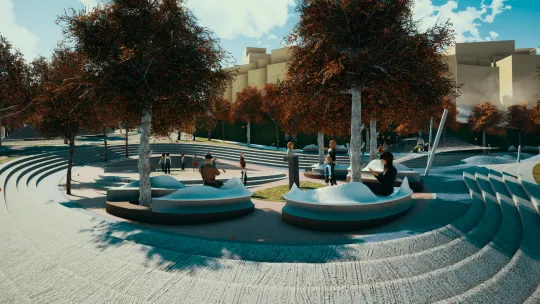
The design of the park is structured through an organic geometry inspired by the movement of the sea, in contrast to the rigidity of the existing urban layout. This fluid topography gradually descends towards the coastline, creating microhabitats, improving landscape integration and enabling a natural and continuous connection between the city and the waterfront. The reuse of existing materials becomes a key strategy within the project, transforming infrastructure and impermeable surfaces into new construction and landscape elements that reinforce the identity of the place and promote the circular economy.
The proposal incorporates advanced criteria of sustainability and renaturalisation, such as sustainable urban drainage systems (SUDS), increased soil permeability, improved vegetation cover and adaptation to rising sea levels. The landscape is organised into ecological bands that respond to the altimetric gradient and proximity to the sea, from submersible areas and dune systems to tree-lined zones that function as climate refuges. On the Fòrum platform, the project proposes a progressive renaturalisation strategy that encourages the emergence of a “third landscape” as a space of ecological transition.
In terms of use and mobility, Olas de la Mar Bella advocates for a more sustainable city model, limiting road traffic and prioritising soft and shared mobility. The park’s routes and spaces are diversified to accommodate social, sporting, leisure and contemplative activities, fostering coexistence, inclusion and a balance between human activity and the presence of nature.
This Master’s Final Project received a special mention at the ESDESIGN Master’s Final Project Awards.


-
Master in Landscape Architecture and Sustainable Urbanism
Spatial DesignThe practice of landscape architecture covers a wide range of professional commissions. The Master in Urban Landscape Architecture equips you with the skills needed to access professional practice with a focus on sustainability, entrepreneurship, and innovation.
In this master’s programme, you will learn to apply concepts such as bioconstruction and xeriscaping, and you will develop the ability to provide strategic consultancy in urban planning, landscape projects, and landscape-related policies.
