




Content creation: Why is it crucial for your projects?
What is content creation?
Content creation is a concept that is part of digital marketing and refers to the production of texts, images, audio, podcasts, videos, or other formats, with the aim of providing information to the end user, educating, entertaining, or persuading them to take a specific action. In addition, it can be shared across different channels.
Nowadays, digital content creation is essential within companies’ marketing strategies. It is an effective way to interact with potential customers, build strong relationships with the target audience, increase brand visibility in search engines, and help differentiate a brand from the competition while positioning it as a reference in its sector or field.
Visibility is part of search engine optimization (SEO) strategies. This involves creating high-quality content that meets algorithm requirements, so it can be perceived as beneficial for the user experience and increase organic traffic to a website.
Types of content
Content creation can be applied to any type of digital format. The most common types of content are the following, each with its own characteristics:
Blog
Blogs are usually a section within a company’s website. They allow companies to share relevant information, such as news, opinions, and advice for their target audience. Blog content can cover a wide range of topics but should align with the company’s activity or the products and services it offers. They are very practical as they can be shared across multiple channels, such as social media.
Social media
Social media platforms are used for content distribution. They allow companies to share updates, promotions, images, and videos with their audience whenever they want, while also segmenting that audience. The most commonly used platforms are Facebook, Instagram, Twitter, LinkedIn, and TikTok, each with its own characteristics and user profiles.
Newsletters
Newsletters are periodic emails that include relevant content for subscribers. They are part of email marketing and are an effective way to stay in touch with the audience, share updates, promotions, and exclusive content, and ultimately foster customer loyalty.
eBooks
eBooks are more extensive digital resources than blog posts and provide detailed information on a specific topic. They are excellent for generating leads, as they are often downloadable in exchange for an email address, and for demonstrating authority in a particular field.
Images and infographics
Images and infographics are visual elements that can also be used in content creation. Tools such as Adobe Photoshop, Canva, or Piktochart are used to create visuals and graphics that can stand alone or complement other types of content to increase visual impact.
Videos
Videos have become one of the most popular types of content among users, which is why almost all social media platforms now support their creation and distribution. They range from tutorials to product demonstrations or customer testimonials. Their main advantage is that they allow messages to be conveyed clearly.
Presentations
Presentations are useful for sharing information in a structured and visually appealing way. Platforms such as Microsoft PowerPoint or Google Slides make their creation easier and add dynamism to content.
Webinars
Los webinars son seminarios online que se celebran en tiempo real. Permiten a los espectadores interactuar con los presentadores y hacer preguntas en directo. Son una excelente manera de compartir conocimientos, generar leads y fomentar la participación de la audiencia.
Podcasts
Podcasts are audio programs that can cover any topic. They are popular because they allow listeners to consume content while doing other activities. In addition, they are very useful for building audience loyalty.
FAQs or glossaries
Frequently Asked Questions (FAQ) sections or glossaries are useful resources for consumers, as they provide answers to the most common customer questions. They are important for delivering quick and easily accessible information about products, services, or company policies.
Why is high-quality content creation relevant?
First of all, high-quality content creation directly impacts web positioning. When content is high quality and truly provides useful information, algorithms can detect it and rank it higher in search results. However, it must also be properly optimized with keywords, titles, and various attributes.
Another reason to create content is that it helps position you as a specialist in a specific field. If your content is interesting and relevant, and if it is designed to answer users’ questions, they will eventually see you as a reference. For that reason, they will return to you whenever they have a doubt or question.
However, given the proliferation of tools for content creation using artificial intelligence, it is important to note that they should not be used as the sole resource. While they can mimic human writing and communication, careful reading can reveal unusual grammatical structures and repetition in content and expressions. Therefore, it can not only appear as plagiarism, but it can also damage a company’s image by showing that quality content generation is not a priority, but merely a strategy to try to rank. Google’s algorithms have already begun filtering some of this content.
High-quality content will eventually generate more visits to a website. But beyond that, it is also necessary to maintain a strong social presence, that is, to have well-optimized channels. Social media, in particular, has become the main distribution channel and can make content go viral in a very short time.
Finally, but no less important, quality content helps users validate their purchase intention. For example, if you are unsure about buying a guitar, but you discover useful content about it on the brand’s blog, there is a high probability that it will influence your final purchasing decision.

What is the content creation process?
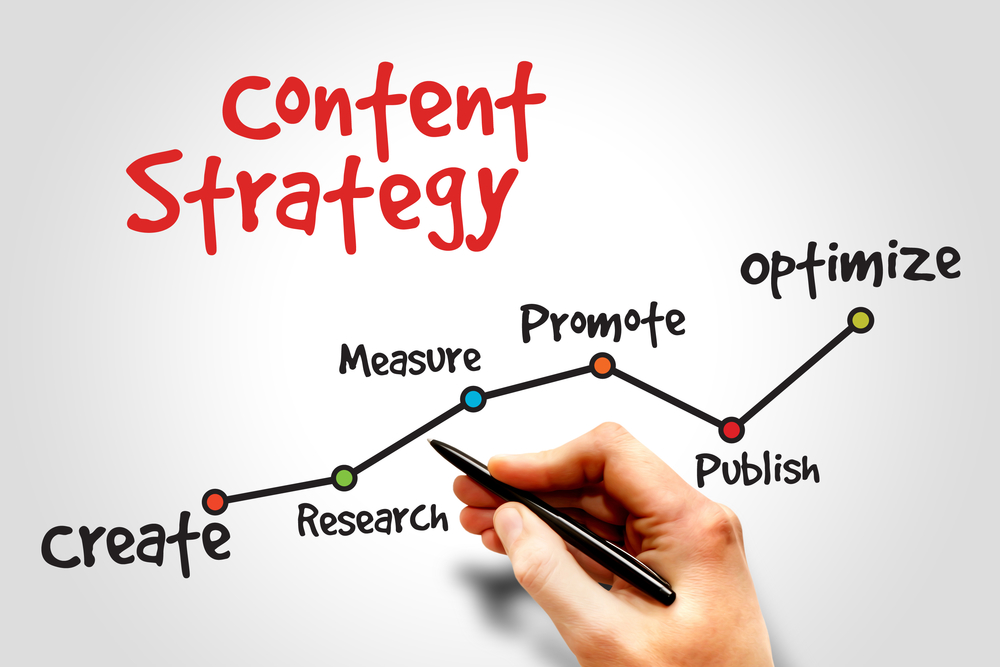
Content creation, as a digital marketing strategy, goes through different stages in order to achieve its objectives of gaining visibility and organic traffic:
Planning
Creating any content requires prior research and documentation. Not only regarding the information itself, but also determining which type of content is most appropriate for each moment and channel. For example, you can plan a number of monthly blog posts along with periodic publications. At the same time, you can plan to share them on social media and create specific content for those platforms, such as videos or images.
Organization
What you want to communicate must follow a clear order and structure. This allows users to follow the content easily and feel engaged. If the content convinces them repeatedly, they may even recommend it. On the other hand, content without a clear structure or with poor visual quality is unlikely to generate interest.
Development
The third phase is the development of content. Once you have decided what type of content you will create, when, and what style and structure it will follow, it is time to take action. You should also conduct keyword research and work on other aspects that contribute to positioning, such as metadata and links.
Clear and concise writing
Another important aspect is the writing style. It must be adapted to the format. The tone used in a blog article is not the same as in a persuasive video. The language can be more or less formal, but it must be clear and adapted to the target audience.
Distribution
Distribution is when you begin sharing your content across different channels. Social media is the main distribution channel, but since there are many platforms, you must first determine which are most relevant for you. Then you can expand gradually as you master your content strategy. Regardless of the format or channel, consistency is key so your audience knows when to expect new content.
Analys
Analysis is the final stage and involves evaluating whether the objectives have been achieved. Any strategy must be measurable. Objectives should be defined beforehand so that results can be compared, determining what works and what does not, and making the necessary adjustments.
Tools for content creation
The choice of tools will depend on the type of content. Written content generally requires fewer tools, as it mainly involves research and writing. However, for other formats, the following tools can be helpful:
Canva
An all-in-one solution for creating visually appealing content, with intuitive use and customizable templates for images, infographics, and graphics.
Adobe Premiere Pro
Allows you to create professional videos with editing features, special effects, and export options.
Microsoft PowerPoint
Ideal for creating presentations with an intuitive interface and advanced design features.
Adobe InDesign
Perfect for creating eBooks and editorial content, with templates and formatting tools.
Zoom
Useful for organizing and recording webinars, with scheduling and live interaction features.
Train today to understand content creation
Companies need professionals like you who are capable of creating high-quality content. The knowledge and tools you need can be acquired in our Master’s in Branding, Creativity and Brand Communication.

