




ESDESIGN explores how AI is transforming designers' work
ESDESIGN, Higher School of Design in Barcelona, part of Planeta Formación y Universidades, publishes Designing with AI: A New Workflow from Idea to Product, a report developed by Marc Ribas Garriga, lecturer on the Master's in Product Design and Digital Modelling, which examines how artificial intelligence is transforming the design process and the designer's role in product development.
From image generation to a new design workflow
Artificial intelligence has accelerated the generation and exploration of design ideas, but its usefulness goes beyond creating images or renders. The report explores how AI can be integrated into the different stages of the process without replacing the designer's judgement or the need for physical product validation.
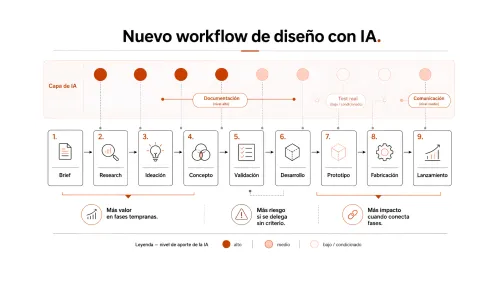
Building on this idea, Designing with AI: A New Workflow from Idea to Product proposes integrating artificial intelligence throughout the entire design process, rather than using it solely at the visualisation stage. Marc Ribas outlines a nine-stage process: briefing, research, ideation, concept development, validation, development, prototyping, manufacturing and launch. At each stage, AI can support research, information analysis, the exploration of alternatives and the anticipation of potential scenarios. At the same time, the report highlights the stages in which first-hand experience, technical knowledge, materials and interaction with users remain essential.
Read the full analysis to discover how to incorporate AI into the different stages of the design process.
Continuing to evolve alongside design and technology
At ESDESIGN, this transformation is also reflected in our teaching, with the integration of AI tools into various programmes, as they offer new possibilities while highlighting the need to analyse their results and reflect on the role designers should play at each stage of the process. This commitment is also reflected in our academic offering, with the launch of the Master's in Artificial Intelligence last year, which allows us to expand our training in this field and explore its applications from a professional perspective.
Through the publication of this report, ESDESIGN also continues to promote research, critical reflection and knowledge creation in design and its various disciplines, bringing its community closer to the transformations reshaping professional practice and the new challenges designers face.
